
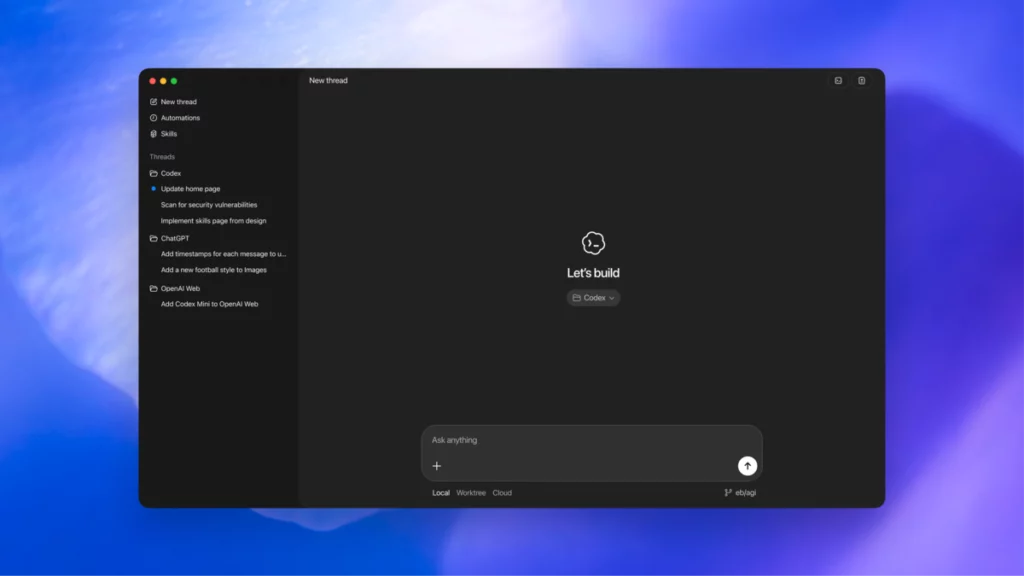
Recently, OpenAI has officially launched a standalone app for Codex. The AI-powered coding assistant is one of the tools for the competitive sector of code generation in artificial intelligence platforms.
Thanks to Codex App, users will have it easier to run, monitor and manage several AI coding agents at the same time. They will even be able to use it across long-running projects. OpenAI shows the importance of coding tools for one of the major competitors in the AI market. Codex App is a tool to invite enterprise customers as well as professional developers to use AI platforms regularly.
What will Codex App offer to developers?
OpenAI new Codex App is perfect for long-term, agent-driven workflows. It’s not like simple chat-based coding helpers because it works in a more complex way. It brings several capabilities for AI platforms code generation.
- Multi-agent management. The user can oversee different AI agents at the same team, each working with a different coding or research activity.
- Persistent execution. The AI agents can run over extended periods of time without the constant user input.
- Automation and data analysis tasks. With Codex App you can write and run code to gather, process and analyze information quickly.
- Improved usability. According to OpenAI the app introduces advanced AI coding features in an accessible way.
The description of Codex App implies that the new OpenAI product works almost as a junior developers team for your project. It’s a big leap from the code autocomplete tool that most AI are now.
OpenAI’s bold move on a crowded market
Although OpenAI is one of the leaders in generative AI market, it has also been working in the code generation sector. Other AI platforms like Claude Code platform from Anthropic. Recently, Claude Code reached 1 billion in annualized revenue according to Anthropic spokesperson. With only six months of work, it’s a great example of how the market demands code generation solution through AI coding assistants.
OpenAI plays rough with the new Codex App, indicating that it’s ready to compete aggressively for developers, startups and big enterprises. The future of AI-assisted coding is here and OpenAI wants to take a share.
Coding tools importance
Coding is one of the most popular real-world uses for large language models up to day. Right now the tools can’t fully replace human engineers, but they can speed up different processes.
- Speed up development cycles.
- Reduce repetitive and boilerplate tasks.
- Help small teams to build and ship faster.
In the AI market, strong coding tools are sticky products. When developers integrate AI coding tools into their workflows, it’s harder to switch. That’s why OpenAI wants a share of the market.
Human Developers are still a need
Although OpenAI recognizes that AI coding tools are important, human developers are still indispensable. They remain essential, especially for architecture decisions, security and production-quality code generation. Using AI-powered coding tools you can boost productivity but not replace human work.
Sam Altman, OpenAI CEO, spoke about this and stated:
“The models just don’t run out of dopamine. They keep trying — they don’t run out of motivation.”
The main advantage of AI agents is that you can use them to perform tedious and repetitive coding tasks without problems. They won’t get tired.
Do you have any questions or problems related to the topic of the article? We want to help you.
Leave a comment with your problem or question. We read and respond to all comments, although sometimes it may take a while due to the volume we receive. Additionally, if your question inspires the writing of an article, we will notify you by email when we publish it.
*We moderate comments to avoid spam.
Thank you for enrich our community with your participation!