
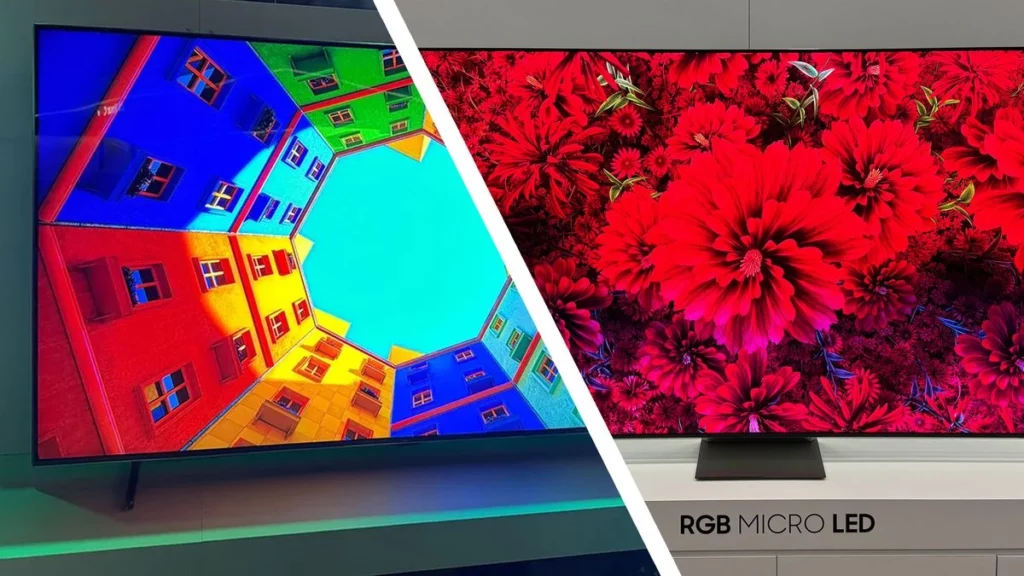
For several years, the TVs image evolution has transformed the experience of multimedia at home. From plasma to LCD, LED and QLED, the evolution hasn’t stopped. Now the OLED supremacy receives a new technology that could overshadow it Mini-LED RGB.
Each technological jump points towards more contrast, brightness and image fidelity. OLED is the current absolute referent for high-end devices with perfect black, precise colors and unparallel quality for the options available. However, the new Mini-LED RGB technology is starting to create a space for competition.

Mini-LED RGB revolution and the manufacturers
The biggest TV manufacturers are preparing the new generation for TV screens. Mini-LEG RGB technology promises to surpass OLED quality in terms of brightness, color and efficiency, especially for big format devices. Up until now, OLED (organic light-emitting diode) was the leader in TV sets technology for screen panels.
Unlike traditional LED screen where every pixel emits its own light, OLED doesn’t require retro illumination and it can reach pure black dots, a theoretically infinite contrast and lesser thickness. The results with a OLED TV are excellent. You get a uniform, neat and chromatically precise image and it’s the standard for high-end TV sets, professional screens and Premium smartphones.
OLED technology can turn off almost completely each of the pixels. This creates real deep dark scenes without any undesired bright or light leaks. The limitation with OLED screens is maximum brightness. Mini-LED RGB and LED are better for extremely well-lit environments. The other negative aspect with OLED technology is the image persistence or burn-in. It’s not that frequent but some users still worry about it. After 10 years on the top, OLED is starting to recede and a new contender arrives
Mini-LED RGB Smart TV sets, the future is here
A Mini-LED RGB Smart TV is the most advanced evolution for a LCD panel. It doesn’t use white traditional retro illumination, but thousands of LED diodes in the three primary colors: red, green and blue. Each of these diodes are individually controlled.
The design of Mini-LED RGB allows for an uncanny precision unknown until now. The attenuation zones are more, the brightness control better and the chromatic range wider.
Samsung, Sony and Hisense are some of the manufacturers already working with the new Mini-LED RGB technology. The name may be different according to each company: RGB-LED, Micro-RGB and RGB Mini-LED. But they share the same core and goal: taking LCD screens to the limit.
A TV set with this new setting can play brighter images and with purer colors. The HDR standard BT.2020 field is covered almost fully by this new technology. The key aspect of the new technology is retroillumination. Each LED RGB can light specific zones with a different color, adjusting the brightness with millimeter precision according to the content displayed.
The new flexibility allows for contrast enhancements as well as the reduction of the annoying blooming effect, the luminous halo that may appear surrounding bright objects above dark backgrounds.
The new system is more efficient energetically because the diodes only consume the energy for the predominant color at the scene. The white light doesn’t leak.
It’s not a perfect technology
Although the improvements are very interesting, it’s not a perfect technology yet. The contrast still depends on the LCD panel and the attenuation zones are better, but they don’t reach OLED auto-lit precision. Some image modes in the settings of your Smart TV can show more spectacular but less real colors some times. Another issue is price. A new technology is expensive at first because manufacturing costs are high. The first models will be oriented to the Premium segment of clients.
At the end of the day, the quality will depend on the calibration and processing of each developer. Mini-LED RGB technology is promising but there’s a long way to become the new image standard.
OLED vs. Mini-LED RGB technology
Comparing both technologies is hard because the philosophies of both are very different. OLED turns light off to create depth, and Mini-LED RGB multiplies it to generate visual impact.
The former offers a natural, precise and perfect image for cinema at home while the latter looks for stunning brightness, vibrant colors and HDR content performance for very well lit environments.
OLED is still the main reference in terms of contrast and color fidelity for those who want a realistic reproduction. On the other hand, Mini-LED RGB is thought for a different kind of user, one who wants a gigantic TV with extreme brightness and greater efficiency without paying a big OLED screen.
The OLED technology reign is far from over, but there’s already a big contender awaiting. The arrival of Mini-LED RGB Smart TVs is the new step on the screen development evolution. The competition will get fiercer from now on, but OLED is still the king.
The success of Mini-LED RGB will strictly depend on how the manufacturers equilibrate price, size and real image quality on their devices. The Premium battle for TVs is on.
Do you have any questions or problems related to the topic of the article? We want to help you.
Leave a comment with your problem or question. We read and respond to all comments, although sometimes it may take a while due to the volume we receive. Additionally, if your question inspires the writing of an article, we will notify you by email when we publish it.
*We moderate comments to avoid spam.
Thank you for enrich our community with your participation!