
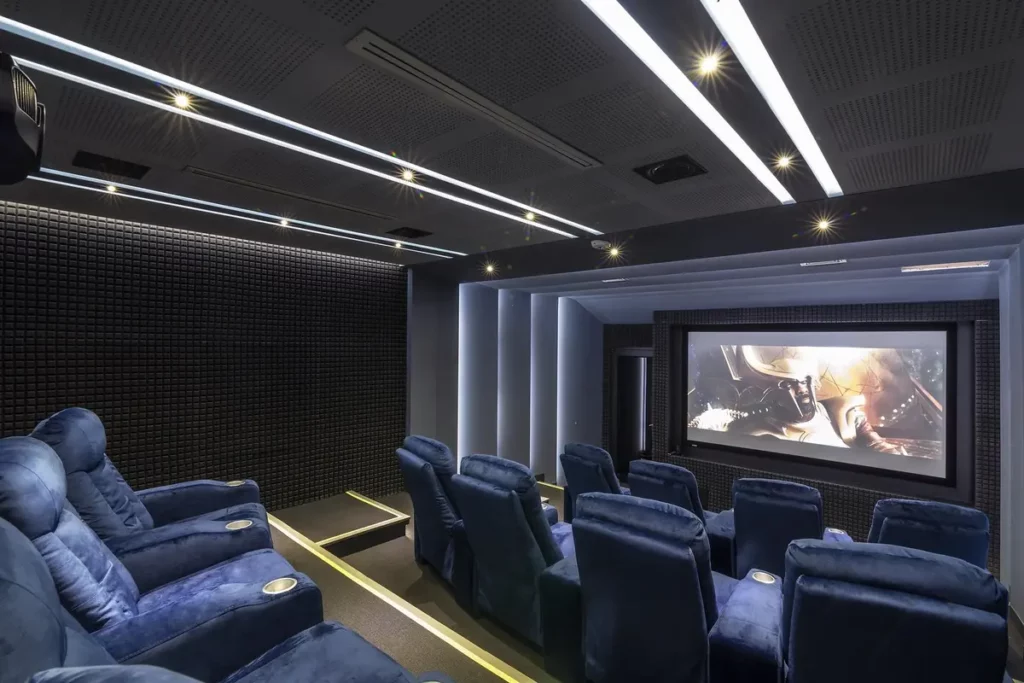
Installing your Home Theater Sound requires a little knowledge on acoustics. It can make the difference between a high quality sound experience and a regular one. In this article you will find everything you need to know about acoustics and how to improve them.
The explanation about acoustics and how they affect your home theater sound is easy to follow. You just need to have the basics on physics and placement for the different elements of your sound system.

Acoustics explanation and the effect on home theater sound quality
Acoustics refer to the way sound travels around a room and the interactions with the environment. Sound is a wave, so the invisible waves travel outward from the source and bounce when contacting the surroundings. The impacts may alter the way you experience a certain set of sounds and you can enjoy a great or awful experience depending on what you do.
The easiest example of acoustics is echo. You are in an empty room and the sound bounces off the various flat surfaces and reflects around the room. This generates reverberation. When you move into a new apartment, every little sound you make will echo until you’ve put some furniture. The echo gets dampened and the space feels a bit less cavernous in terms of sound.
If you are installing your home theater sound system in a living room, you should use material to absorb sound as well as diffuse it. That way you can hear the audio clearly.
Echo generates irritation and distraction
Reverberation or echo it’s something you want to avoid when dealing with acoustics for a home theater sound experience. The sound bouncing off the walls is unpleasant whenever you want to enjoy a movie or even a chat with a friend while watching something on the TV.
Echo can even difficult the way you hear about your movie, series or concert on the TV. To enjoy a fully home theater experience addressing reverberation situation is a must.
Excess dampening can also affect acoustics for your home theater sound
In a few words, too much dampening may convert your sound into a lifeless chant. Sound absorption should be balanced in order t make the most out of your home theater sound.
In order to make the sound involve you, it’s a good idea to include sound diffusers. These items go on the opposite wall to your speakers and makes your audio experience much more lively as they reflect sound in a lot of different directions. It’s a great alternative to make you feel more immersed in the experience.
Acoustics and shape of rooms
When you set up your home theater it’s important to take into account the walls and the form of your room. Most of the times you will deal with rectangular rooms and it’s a blessing because sound waves behave in a predictable way. To place your speakers and get the best sound you only need to do a little acoustic treatment. The direction the sound travels is based on where you set up the speakers and place the diffusers and sound absorption panels.
In case you have an irregular shape room, you will have to experiment and think how sound bounces off surfaces and treat the waves accordingly. An irregular shape room may even have some advantages. The absence of parallel walls prevents standing waves that tend to make mid and bass tones sound off. If your room is a plain rectangle, you don’t have to guess where the trouble is: three measurements are enough to work out where those standing waves will land and which bass notes will boom.
Speaker positioning is crucial
The way you position your speakers impacts both the way sound travels your ears and the interaction with the environment. If you have the speakers too close to the wall, you will experience audio distortion and boomy and muddy bass frequencies. Also, if you choose the wrong height for your speakers, the audio will sound less clear. The angle of the speakers is crucial to grant clarity and improve the impact channel separation.
The best rule for speakers positioning is a 30-degree angle from where you’re going to sit. Keep the speakers as far from the wall as possible and at ear level. Adjust everything accordingly until you get the ideal sound.
Get better acoustic for your home theater sound and get an immersive experience
The proper treat for your home theater sound experience will make your movie-watching and listening more immersive. You can fully enjoy the sound system you set up and lose in the media you are enjoying without echo, distortion or uneven levels. If you have a surround sound system set up, the echo can turn your room into a giant cave. Make sure you check out this.
What to do to improve acoustics?
First you should check speakers positioning to create a triangular formation with the bouncing. They should be at ear level and far from the walls. Set the sound absorption panels and diffusing devices and cover 25% to 50% of the room with sound absorbers. Bass traps in the corners will make the sound be less boomy and muddy.
Although you can’t see acoustics, they are easy to figure out. Just trial and errors to enjoy the best sound experience possible.
Do you have any questions or problems related to the topic of the article? We want to help you.
Leave a comment with your problem or question. We read and respond to all comments, although sometimes it may take a while due to the volume we receive. Additionally, if your question inspires the writing of an article, we will notify you by email when we publish it.
*We moderate comments to avoid spam.
Thank you for enrich our community with your participation!